Behaviour is a signal from the environment
The environment is the first variable to examine. Behaviour is communication, not defiance.
The law already requires neuroinclusive design. Six regulatory instruments define what must change. The EIF is the only framework that unifies them — through the neuroscience that explains why it all works.
Design for the 15–20% who need it most. Improve outcomes for everyone.
The first framework that measures and manages environmental cognitive load.
Every environment imposes cognitive load. Lighting, noise, unpredictability, social complexity, information overload — all of it consumes the same finite resource: working memory.
Neurodivergent people hit overload first. They are the early warning system. But the load is affecting everyone — every child in the classroom, every employee in the office, every member of the household. When you reduce unnecessary environmental cognitive load, outcomes improve universally.
This isn't accommodation. It's performance science.
The EIF maps a single causal chain. Change the first variable and everything downstream changes with it.
Sensory, spatial, relational, temporal
Processing demand, regulation cost
Regulation, communication, interaction
Engagement, belonging
Measured, not assumed
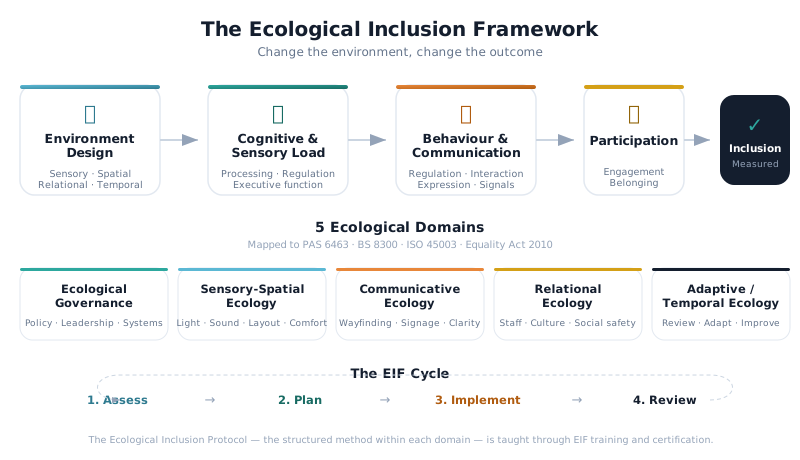
The philosophical foundation. The implementation method is taught through training and certification.
The environment is the first variable to examine. Behaviour is communication, not defiance.
Working memory is finite for every brain. Environments that consume it through overload leave less capacity for the task at hand.
Rather than changing people to fit environments, the EIF changes environments to support people. This is both a moral and legal position.
Environments that work for neurodivergent people work better for everyone. The universal benefit is not a side effect — it's the point.
Not compliance. Not tolerance. Participation — active, autonomous engagement. The EIF measures whether people can function, not whether they appear to cope.
The EIF examines every environment through six interconnected ecological lenses — with Governance as the foundational umbrella across all six. The specific assessment tools and scoring methods within each domain are part of the Ecological Inclusion Protocol.
Light, sound, thermal comfort, layout, biophilic elements — how the physical environment supports or disrupts neurological regulation.
How information, tasks, and expectations are structured — instruction clarity, task sequencing, working memory demands, predictability, and cognitive load management.
Wayfinding, signage, and information systems — physical and digital — that minimise cognitive load through clarity and consistency.
How interpersonal dynamics and social expectations shape participation and identity safety — belonging, peer dynamics, masking pressure, authentic expression.
How environments support nervous system safety, co-regulation, and emotional stability — predictability of responses, attunement, and tolerance of distress.
Time structure — routines, transitions, pacing, recovery, circadian alignment, seasonal patterns. How the environment unfolds over time.
Policy, leadership, accountability, resources, and review. Governance isn't a domain — it's the infrastructure that makes all six domains deliverable and sustainable.
Within each domain, trained practitioners apply structured assessment tools mapped to PAS 6463, BS 8300, ISO 45003, and the Equality Act 2010.
The EIF doesn't invent requirements. Six regulatory instruments already demand neuroinclusive design. The EIF is the only system that unifies them through applied neuroscience.
Anticipatory duty to remove barriers. Reasonable adjustments. No diagnosis required.
Assess–Plan–Do–Review. Graduated approach. Statutory duties for schools. Rights for parents.
Design for the Mind. First national guidance for neurodivergence in built environments. Likely mandatory by 2030.
Accessibility of buildings. The established compliance framework. EIF domains map directly to BS 8300 sections.
Psychological health and safety at work. Psychosocial hazard identification. 74-country consensus.
Quasi-statutory. Referenced in Employment Tribunals. Covers adjustments, recruitment, management.
"Disability is created by barriers in society, not by conditions in people. When we change the environment, we change outcomes."— Social Model of Disability, operationalised through the EIF
This isn't a philosophical position — it's a legal one. The Equality Act 2010 places an anticipatory duty on organisations to remove barriers before they cause disadvantage. The EIF provides the methodology to meet that duty — and the neuroscience to show why it improves outcomes for everyone.
The EIF is implemented through a structured method that enables practitioners to measure environmental cognitive load and redesign conditions for measurable improvement.
The full method is taught through EIF training and applied through the certification programme.
EIF practitioners are trained to apply the framework across schools, workplaces, and family settings. They use EIF tools and methods to measure cognitive load, guide environmental redesign, and prepare organisations for certification.
SENCOs, headteachers, governors, education consultants
HR directors, D&I leads, facilities managers, consultants
Parents, carers, family support workers, SEND advocates
From understanding to becoming a model for others.
Free assessment. Read the book. See where the gaps are.
Learn the method through live training or the Neuroinclusion Framework.
Use EIF tools to measure, redesign, and track outcomes.
EIF Accreditation — Aware, Accessible, Exemplary. Measurable recognition.
Take a free assessment, explore the training, or discuss certification for your organisation.