⚖️ The Regulatory Stack
The EIF doesn't invent requirements. It unifies seven existing instruments through applied neuroscience — the only framework that connects them into a single operational system.
Equality Act 2010
Anticipatory duty to remove barriers. Reasonable adjustments. No diagnosis required. The foundational anti-discrimination law that governs all settings.
SEND Code of Practice 2015
Assess–Plan–Do–Review cycle. Graduated approach. Four areas of need. Statutory duties for schools. Rights for parents. The bridge between schools and families.
PAS 6463:2022 (BSI) — Design for the Mind
First national guidance for neurodivergence in built environments. Covers lighting, acoustics, wayfinding, sensory load. The EIF's 6 ecological domains provide a structured pathway to PAS 6463 alignment.
BS 8300:2018 — Accessibility of Buildings
The established accessibility code of practice. EIF domain structure maps directly to BS 8300 sections. Organisations already know this framework.
ISO 45003:2021 — Psychological Health at Work
Psychosocial hazard identification and management. Includes environmental stressors that disproportionately affect neurodivergent workers. The primary instrument for workplaces.
ACAS Neurodiversity Guidance
Employer duties. Referenced in Employment Tribunals. Covers adjustments, recruitment, management, disciplinary considerations.
UN Convention on the Rights of Persons with Disabilities (CRPD)
The international framework for disability rights. The EIF's ecological domains map directly to CRPD articles on accessibility, education, work, and participation. Adopted as a guidance document for the EIF. Full CRPD Articles →
🧠 Zoe Aspinall's applied neuroscience is the connective layer — the mechanism that explains WHY these instruments work and HOW to implement them as a single system.
🧠 Neuroscience Foundations
The EIF is grounded in established neuroscience that explains how environments shape cognitive performance, regulation, and participation — in every brain, not just neurodivergent ones.
Cognitive Load Theory
Working memory has finite capacity — for everyone. Environmental complexity consumes resources that should be available for learning and work. Reducing load improves performance universally.
Sensory Processing
Neurodivergent individuals process sensory input differently, hitting overload thresholds first. But sensory load affects all brains — the threshold is the variable, not the mechanism.
Executive Function
Planning, inhibition, and flexible thinking are environment-dependent. Unpredictable or overstimulating environments degrade executive performance across neurotypes.
Polyvagal Theory
The nervous system constantly assesses environmental safety. Threat-detection in hostile environments triggers dysregulation before conscious awareness — in every brain.
Biophilic Design
Natural elements, daylight, and organic materials reduce stress and improve cognitive performance. The effect is universal; the need is greater for neurodivergent people.
Environmental Psychology
Physical environments shape behaviour independently of individual characteristics. Design is an intervention, not a backdrop. The curb-cut effect applies to cognitive environments.
📐 The 6 Ecological Domains
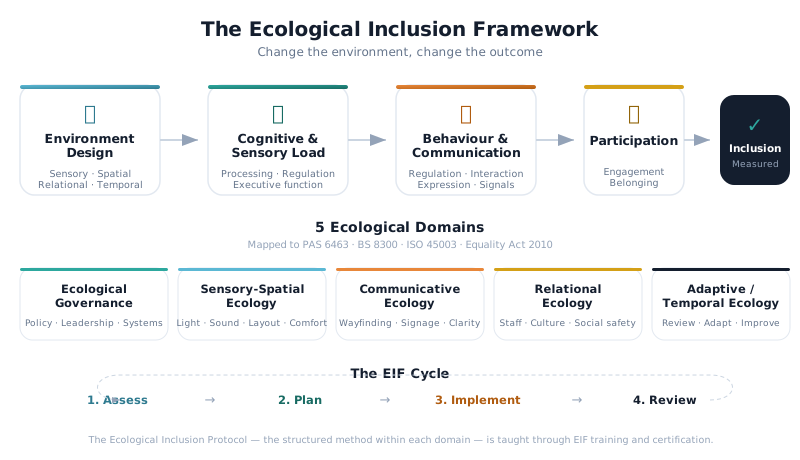
The EIF examines every environment through six interconnected ecological lenses — each mapped to specific clauses of the regulatory stack — with Governance as the foundational umbrella across all six.
Sensory-Environmental Ecology
Physical and sensory conditions — light, sound, thermal comfort, layout, biophilic elements — and their impact on neurological regulation for everyone.
Cognitive-Executive Ecology
How information, tasks, and expectations are structured — instruction clarity, task sequencing, working memory demands, predictability, and cognitive load management.
Communication-Language Ecology
Wayfinding, signage, and information systems that minimise cognitive load through clarity, consistency, and multimodal communication.
Social-Relational Ecology
How interpersonal dynamics and social expectations shape participation and identity safety — belonging, peer dynamics, masking pressure, authentic expression.
Emotional-Regulatory Ecology
How environments support nervous system safety, co-regulation, and emotional stability — predictability of responses, attunement, tolerance of distress.
Temporal-Processing Ecology
Time structure — routines, transitions, pacing, recovery periods, circadian alignment, seasonal patterns. How the environment unfolds over time.
Ecological Governance — The Umbrella
Policy, leadership, accountability, resources, and review. Governance makes all six domains deliverable and sustainable.
The NeuroInclusive Standard
The first framework that measures and manages environmental cognitive load. Comparable to WELL for health, LEED for sustainability, and Montessori for education.
Explore the certification pathway →🔬 Pilot Programme
The EIF is being developed and tested through structured pilots across three settings. Outcome data is being collected to build the evidence base for the cognitive load standard.
Schools
Primary and secondary schools implementing the EIF audit and environmental redesign. Impact data being collected across behaviour incidents, attendance, and learning outcomes — for all students, not just SEND.
Workplaces
SMEs and public sector organisations piloting the workplace audit and manager training. Pre/post data on productivity, sick leave, retention, and reasonable adjustment requests.
Families
Parents in the Family Programme tracking changes in home environment, child regulation, family stress levels, and school relationships. Qualitative and quantitative outcomes.